The Silence of Jev: Why AI’s Next Breakthrough May Not Be a Chatbot
For the past several years, the artificial intelligence landscape has revolved around a single obsession: building models that can communicate like humans. ChatGPT, Claude, Gemini, and their competitors have turned conversation into the dominant interface for AI. Models write, explain, summarize, reason, and interact through natural language.
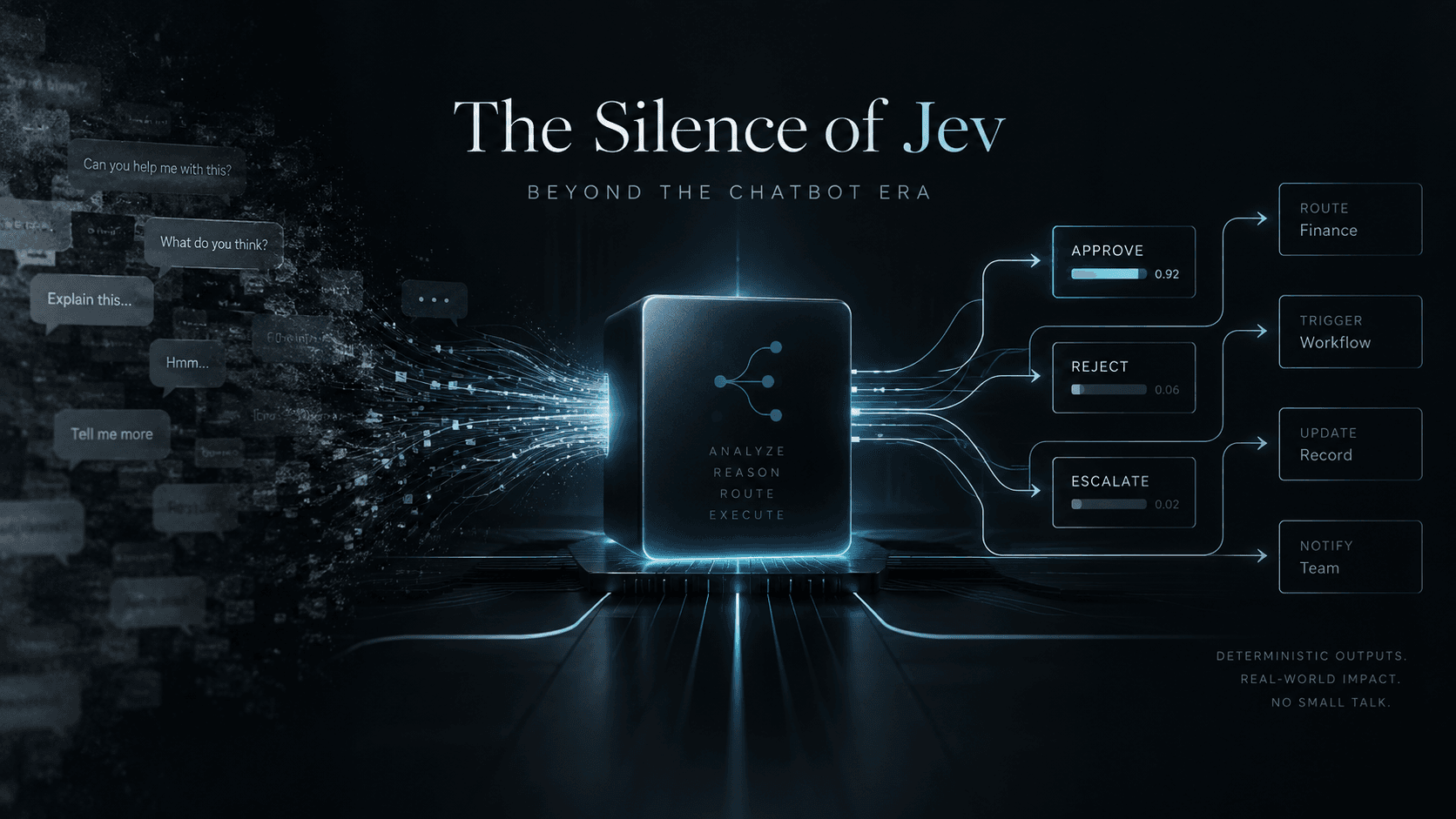
But the emergence of TypeSafe AI and its inaugural model, Jev, points toward a very different direction: silent, probabilistic, machine-native intelligence designed to live inside software rather than talk to its users.
Founded by Diogo Almeida, a former OpenAI researcher and co-inventor of RLHF, TypeSafe AI emerged from stealth on September 15, 2026, backed by $40 million in seed funding. Rather than entering the increasingly crowded market for general-purpose conversational models, TypeSafe is pursuing a different category entirely.
Jev is what the company describes as a "System One" decision model. Its purpose is not to generate language. Its purpose is to decide.
From Conversational AI to the "Smart IF"
Most modern AI systems are built around generation. You provide context, the model interprets it, generates tokens, explains its reasoning, and eventually produces an answer. Jev removes most of that process. It does not hold conversations, write essays, or produce long explanations. Instead, it receives a state or context together with predefined questions and returns structured decisions, probability distributions, and confidence values.
The easiest way to understand Jev is as an intelligent if statement embedded inside an application. Traditional software branches on deterministic values:
Jev allows applications to branch on judgments that are much harder to express as conventional rules:
That distinction matters. Instead of asking a large language model to analyze a situation, explain itself, produce JSON, and hope that the output conforms to the expected schema, developers can ask Jev to make a narrowly defined decision directly. Architecturally, Jev is still built on a transformer foundation, but TypeSafe trains it using RLCD — Reinforcement Learning for Calibrated Decisions — rather than conventional RLHF. Its output space is deliberately constrained.
Rather than generating arbitrary text, Jev supports several structured decision formats, including:
- Boolean decisions, such as Yes/No, with associated probabilities.
- Selection among predefined alternatives.
- Numerical scoring within a defined range.
This does not make incorrect decisions impossible. What it does remove is an entire class of problems associated with open-ended text generation: malformed responses, invented formats, verbose reasoning, and outputs outside the set of possibilities defined by the application. The model cannot suddenly answer a routing question with a paragraph. The application defines the universe of valid outputs. Jev decides where within that universe the current situation belongs.
The Economics of Intelligence Inside Software
Jev becomes particularly interesting when you stop thinking about AI as something a user interacts with and start thinking about it as something software calls continuously. The economics change dramatically. In TypeSafe's published benchmarks against OpenAI's GPT-5.6 Terra, Jev completed decision requests in approximately 0.114 seconds, compared with 8.566 seconds for GPT-5.6 Terra. The pricing difference is even more striking. TypeSafe lists Jev at approximately $0.042 per million input tokens, with no output-token charge, while the comparison pricing cited for GPT-5.6 Terra is $2.00 per million input tokens and $12.00 per million output tokens.
For structured decision workloads, TypeSafe claims Jev can be as much as 238 times cheaper than higher-end models such as Claude Fable 5.1. Those numbers are not merely about making existing AI workflows cheaper. They potentially change which workflows are economically viable in the first place. A company may hesitate to invoke a frontier LLM thousands or millions of times per hour for relatively small classification or judgment tasks. But if inference becomes fast enough and cheap enough, those decisions can begin appearing everywhere. Which leads directly to the model's name.
The High-Volume Reality of Machine Decision-Making
This is the environment Jev appears designed for. Not occasional conversations. Not creative writing. Not research assistants. But high-volume, repetitive, application-level decisions. Potential use cases include:
- Customer-support ticket routing.
- Content moderation pipelines.
- Sales lead scoring.
- Eligibility evaluation.
- Fraud or anomaly triage.
- Jailbreak detection.
- Ranking and classification systems.
- AI-agent guardrails.
- Post-execution review of agent actions.
- Workflow routing and escalation.
Imagine an autonomous coding agent completing hundreds of operations. A general-purpose LLM may perform the work, while a lightweight decision model independently evaluates each action:
Is this operation risky?
Does this change require human approval?
Is this output consistent with the task?
Should the agent continue?
In that architecture, Jev does not replace the larger model. It becomes a decision layer around it. That distinction may ultimately prove more important than replacing one chatbot with another.
The Boundaries Matter
TypeSafe is also unusually explicit about what Jev should not be used for. According to its documentation, the model currently struggles with areas such as literal text extraction, arithmetic operations, date and time comparisons, and contexts overloaded with irrelevant or adversarial information. That limitation reveals something important about the philosophy behind the system. Jev is not trying to become another universal model. Developers are expected to keep deterministic computation where it belongs: inside deterministic software.
- Need to calculate a percentage? Use .
- Need to compare two timestamps? Use .
- Need to parse an exact identifier? Use .
- Need to judge whether a support request sounds urgent based on several paragraphs of context? That is where a model like Jev becomes interesting.
The architecture is therefore not:
AI replaces software logic.
It is closer to:
Software handles what can be calculated. AI handles what must be judged.
That boundary is arguably one of the most important design decisions in modern AI engineering.
Intelligence Without Conversation
The most interesting thing about Jev may not be its speed, its pricing, or even its architecture. It is what the model represents. For years, the industry has implicitly treated language generation as almost synonymous with artificial intelligence. Better AI meant better conversations, longer context windows, more sophisticated reasoning traces, more natural responses and more capable assistants. Jev challenges that assumption. When asked whether TypeSafe AI intends to become another "frontier lab," Diogo Almeida argued that he would rather the company's primary product be intelligence itself rather than the fear or hype surrounding increasingly large models. That philosophy points toward a different future for AI.